
DRIFT
Context-heavy setup
See which repo layers are carrying too much memory, instruction weight, or setup noise before new projects inherit the same sprawl.

VibeSmith
VibeSmith gives multi-repo teams one place to review active components, dependency risk, and context-heavy reuse across Cursor and Claude Code workflows. It is open-source on GitHub, with prerelease installs available today.
If kickoff quality drops after repo three, start here.
WHAT SURFACES FIRST
VibeSmith is most useful when your team needs one visible layer for setup drift, reuse risk, and context-heavy sprawl across repositories.
DRIFT
See which repo layers are carrying too much memory, instruction weight, or setup noise before new projects inherit the same sprawl.
REUSE
Review what needs to move with a component so copy-paste bootstrap stops failing in partial, expensive ways.
RELEASE
Surface linked risk earlier so release-week review is not the first time your team sees the coupling.
FIRST-WEEK PAIN
The common request is not another AI feature. It is a clearer operating view across repos.
Need 01
Teams lose time when rules, commands, and guidance look similar but differ just enough across repos to change behavior.
Need 02
Users want to copy safe baselines, not half-working fragments that hide dependencies until later.
Need 03
Mixed memory layers and stale assets create token waste, noisy prompts, and longer review loops.
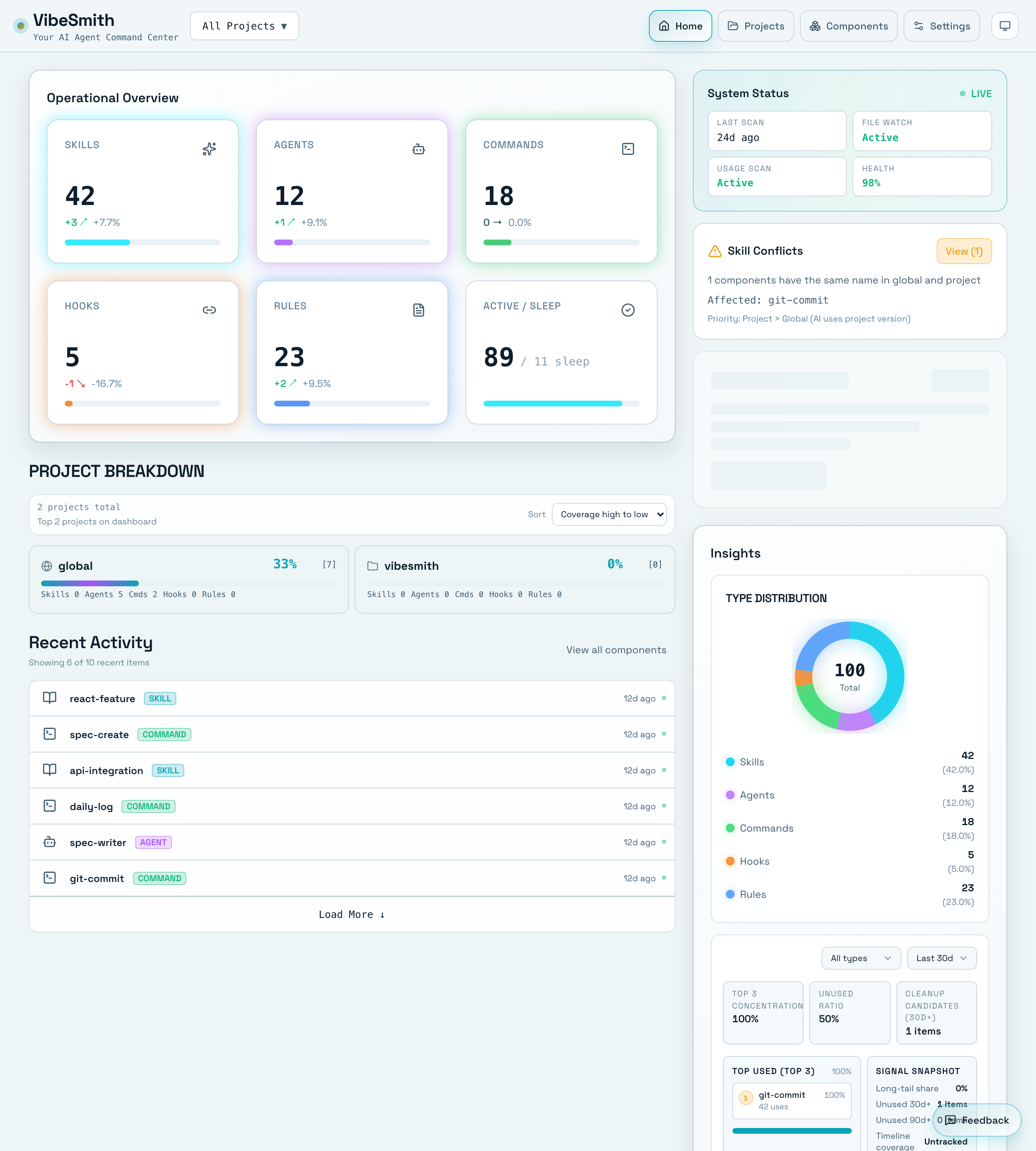
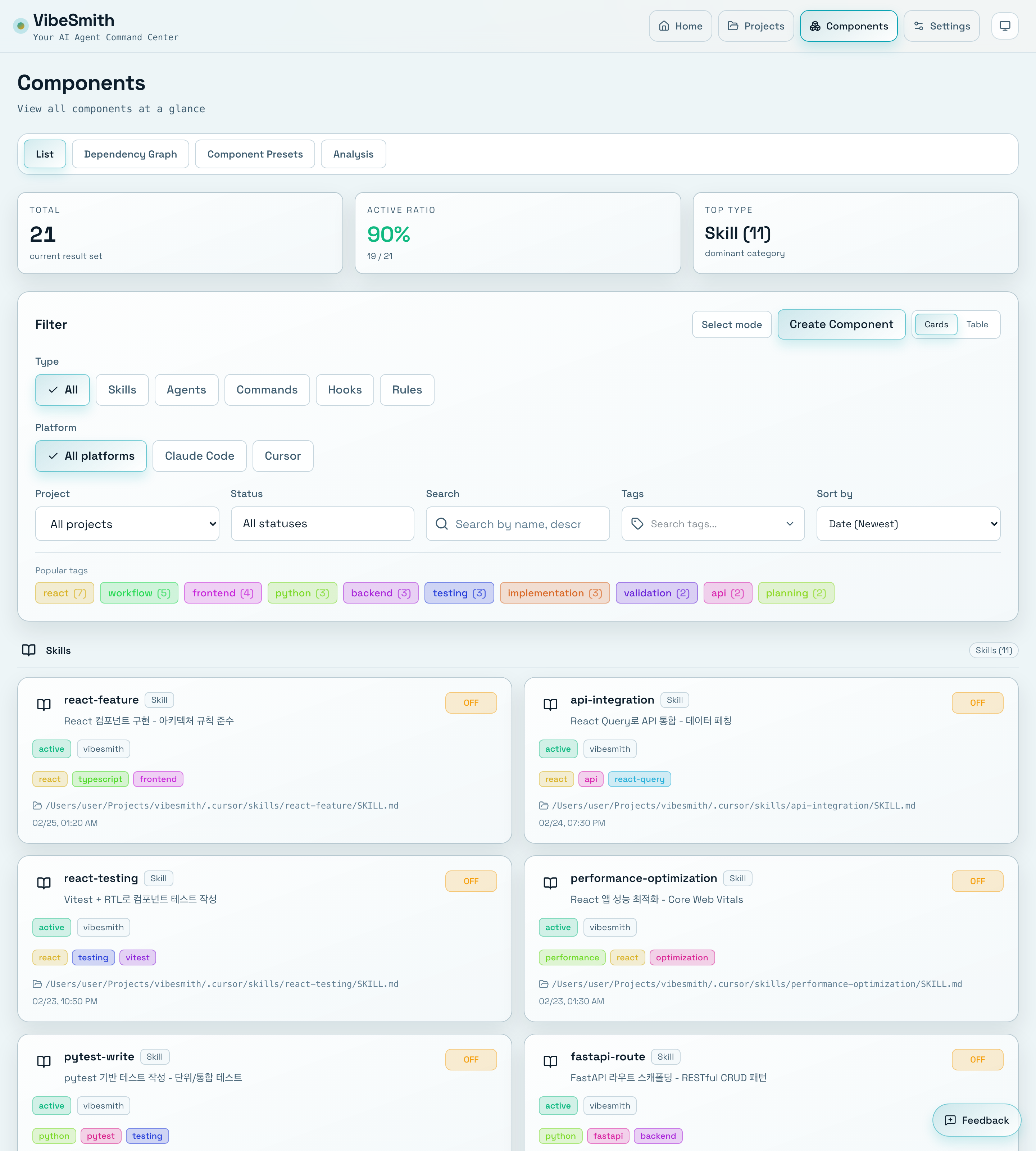
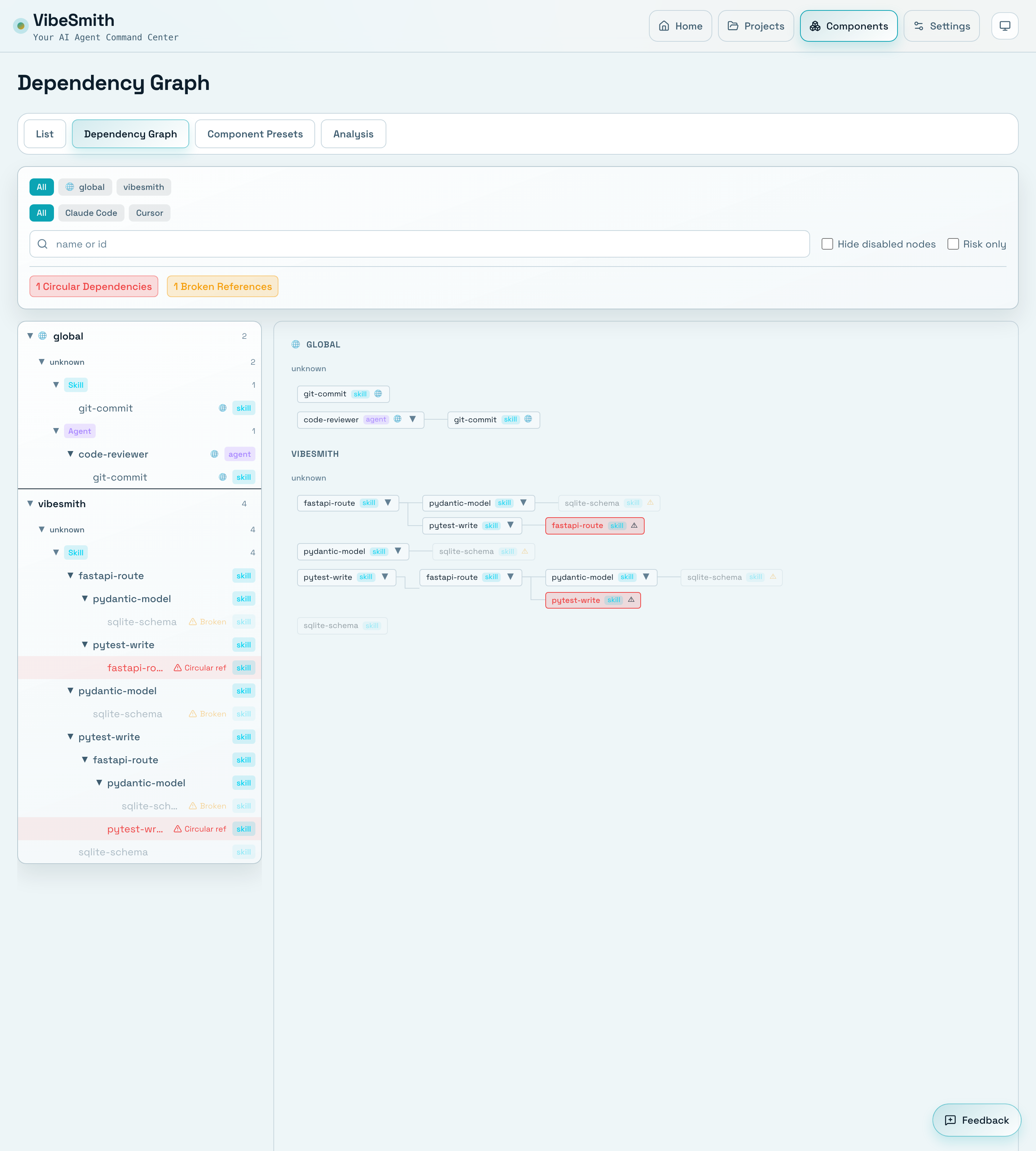
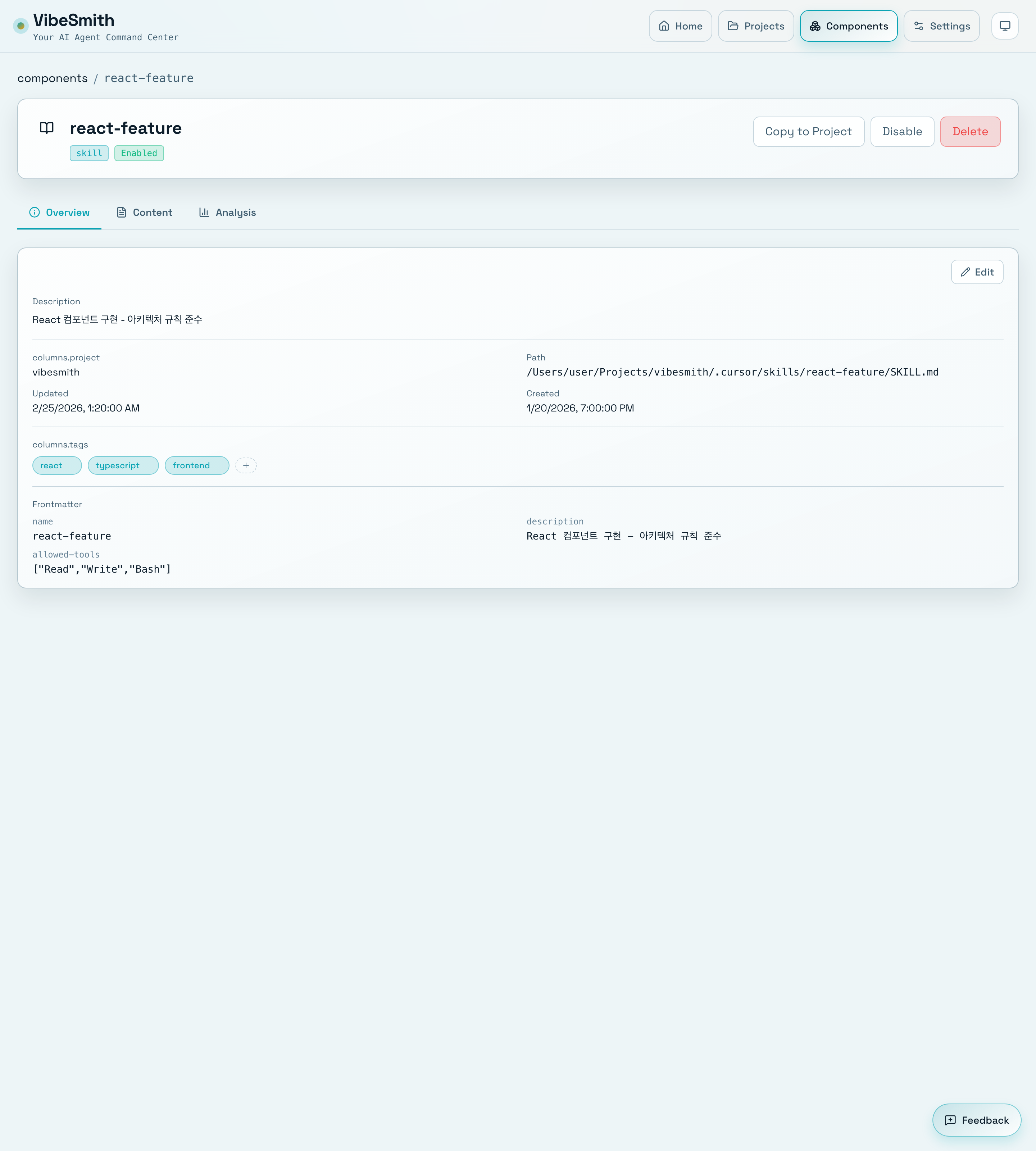
Visual Proof
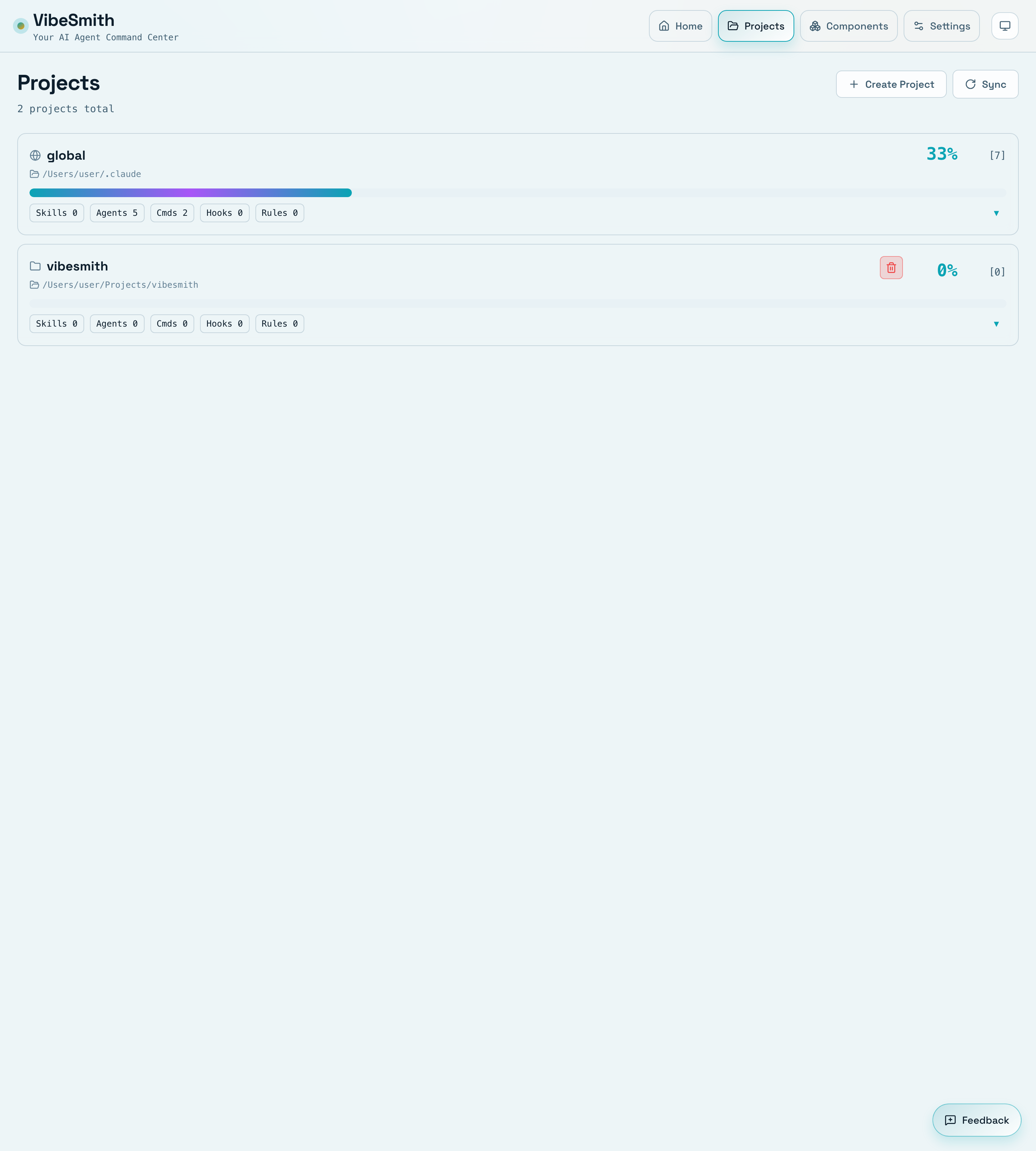
Start with the inline walkthrough, then inspect each decision screen below.
Use the inline walkthrough for the overall flow, then inspect the still screens below for specific decision points.
Core Workflows
Unified inventory + search shows which Skills, Agents, Commands, Hooks, and Rules are still active across projects.
Copy components with dependency-aware flow so bootstrap stays coherent instead of breaking in partial ways.
Preview and apply with conflict policy so teams can judge the blast radius before updating shared setup.
Dependency graph, conflict review, and project scope views make hidden coupling easier to catch earlier.
Why This Matters
Cursor, Claude Code, and MCP are strong local tools. The systems gap appears when teams need the same operating clarity across multiple repos.
Cursor's session-scoped context pushes teams to externalize reusable standards instead of relying on chat memory.
Multi-scope memory/settings in Claude Code increase consistency overhead without a shared operating layer.
MCP expands capability, but server scope and permission boundaries need explicit review discipline.
FIRST-WEEK METRICS
You can judge early value from one repo. The question is whether the baseline becomes clearer, not whether a big rollout already happened.
Outcome 01
Time from install to a baseline your team would actually keep.
Outcome 02
Whether copied rules, commands, and components stay coherent after the first reuse.
Outcome 03
Which stale, conflicting, or overgrown assets you can remove before context quality degrades.
ADOPTION PATH
You do not need an org-wide migration. Start small, measure drift, then expand only if the baseline improves.
Step 1
Install the open-source build and scan the repo that keeps reopening the same setup questions.
Step 2
Use inventory, detail, and dependency views to see what breaks when setup is copied by memory.
Step 3
Decide whether another repo should adopt the same baseline after one team can explain the setup clearly.
Adoption Boundary
Clear boundaries help multi-repo teams decide quickly without overcommitting.
Current scope stays narrow on purpose. The goal is visible proof before wider automation promises.
Download
Choose the GitHub release page, direct DMG download, or Homebrew install path.
Open the latest release notes, download the signed DMG, or inspect the open-source repository.
Latest GitHub release
https://github.com/aroido/vibesmith/releasesLatest install package
https://github.com/aroido/vibesmith/releasesGitHub repository
https://github.com/aroido/vibesmithLatest public build: GitHub release channel, including prereleases.
GitHub is the canonical public release channel. GitLab remains a legacy mirror only.
The GitHub Homebrew tap tracks the same public release channel. Install with Homebrew, or retap first if you used the old GitLab path.
Install and upgrade
brew update
brew tap aroido/vibesmith https://github.com/aroido/homebrew-vibesmith.git
brew install --cask aroido/vibesmith/vibesmith

# If an older version is already installed:
brew update
brew upgrade --cask --greedy aroido/vibesmith/vibesmith
Prefer this path for Homebrew installs and upgrades. If you used the legacy GitLab tap, run `brew untap aroido/vibesmith` before retapping.
The open-source build is the fastest way to see whether component sprawl, hidden dependencies, and context-heavy setup are already slowing your team. If you want outside eyes on one live repo, request an audit after the demo or install pass.